
Rating: B
Dir: T.F.Mou
Star: Hsu Gou, Gang Wang, Andrew Yu
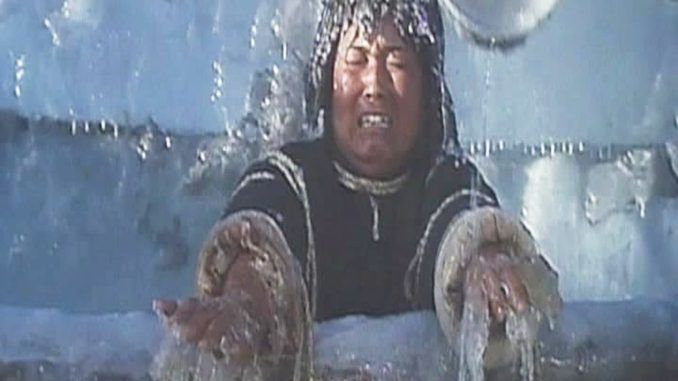
It has probably been close to 20 years since I watched this, and a lot of water has gone under the bridge since. Historically, the Japanese medical experiments depicted here are much more widely-known now; cinematically, “torture porn” has become a regular subgenre of horror, depicting things which were just about never seen, when this was released in 1988. Would it still stand the test of time? The answer turned out to be: better than I expected. There is still a lot of stuff here that’s hard to watch, simply because of the harsh brutality of the “scientists”, which is given the perfect emotional backdrop by the chilly Northern Chinese landscape. You have to keep reminding yourself that, no, it’s not only a movie, and that much of what you see is likely an accurate depiction of (or, at least, no worse than) what actually went on. It’s a 1-2-3 punch which few other films can match: a relentlessly downbeat tone, rubbing your face in the worst excesses of humanity, and not being made up by some imaginative sicko.
Not to say there aren’t mis-steps, most notably the animal cruelty (more on which in a moment), reminding you that, no matter its historical background, this remains an exploitation movie – one where even the Japanese characters speak in Chinese. And yet, while it would have been easy to paint the villains with one colour, that isn’t the case: the Youth Corps of draftees, assigned to the camp, are shown with some compassion, resisting the notion beaten into them, that the subjects are less than human. On the other hand, General Ishii (Wang) and his cronies such as Tamamura, are painted as soulless elitists, prepared to go to any length to defend the Empire. Their complete disregard for any non-Japanese (and it’s worth mentioning, the victims include a Russian woman and her daughter) is genuinely troubling. Admittedly, when the end comes, Ishii has to be dissuaded from ordering everyone to commit suicide and destroy all the data, so at least his disregard for human life extends to his own. Fair’s fair, I suppose.
 The most notorious scene has a cat apparently being thrown in to a room full of rats and eaten alive. There’s some question of whether it’s genuine or not: the director’s statements have been inconsistent. In one interview, he asked to change the subject, but in another, said the cat was merely “tired”. However the offered explanation of “dyed honey” seems a stretch – and there’s also the subsequent scene, which unarguably shows real rats, set on fire, so it’s not as if Mous is exactly a friend to all the animals. [He also used a genuine corpse in Men, for the autopsy footage]. That’s a pointless exercise in cruelty, that weakens the overall tone, by acting as a distraction from what matters: man’s inhumanity to man, to quote Robert Burns. As an illustration of that, this has rarely been equalled in any fictional film.
[10] In the last days of WW II, the Japanese developed bacteriological weapons: 731 Battalion, in occupied Manchuria, was a top-secret establishment for testing these on the local population. ‘Man Behind the Sun’ describes the activities that went on, in graphic detail, yet manages to avoid the pitfalls of other pseudo-historical docudramas. It devotes time to building the characters: although the sympathy is clearly with the victims, the Japanese are not sneering caricatures but real people who believed they were doing the best for the Empire. This makes it even more harrowing as they lose all human emotions towards their test subjects, or ‘marutas’ as they call them (in an effort to dehumanize them, just as the Americans called the Vietmanese ‘gooks’). Even though half an hour elapses before the first atrocity, this is no sanitised TVM, it’s a slow descent into hell. Great detail is paid to historical accuracy – we get victims’ names and ages, dates and places which contrasts markedly with the fast & loose approach of more exploitative films. There’s no morally sound, happy ending, either – this could well be the ‘Henry’ of war movies. It’s not a film to enjoy, or even to like (and so can’t be ‘marked out of 10’) but it’s undoubtedly one to be respected.